


Corrugated Sidewall • Cleated • Steep-Incline • Vertical Conveying
Engineered for Mining, Quarrying, Crushers, Cement, Ports, Fertilizer, Steel, Power & Bulk Material Handling
Pulveizer Sidewall Conveyor Belts are engineered bulk-material conveying solutions designed to move material safely on steep inclines, through complex elevation changes and, where the conveyor system is suitably designed, toward vertical conveying. The system combines a reinforced base belt with corrugated rubber sidewalls and transverse cleats/flights. This creates a contained carrying pocket that reduces material rollback and allows substantially greater elevation gain within a shorter conveyor footprint than a conventional troughed conveyor.
The belt construction is application-driven: carcass strength, cover compound, sidewall height, cleat geometry, cleat spacing, belt width, pulley arrangement, transition geometry, speed, material density and particle size must be selected as one integrated system. Pulveizer can develop the belt configuration around the conveyor duty rather than treating the sidewall belt as a standard flat-belt product.
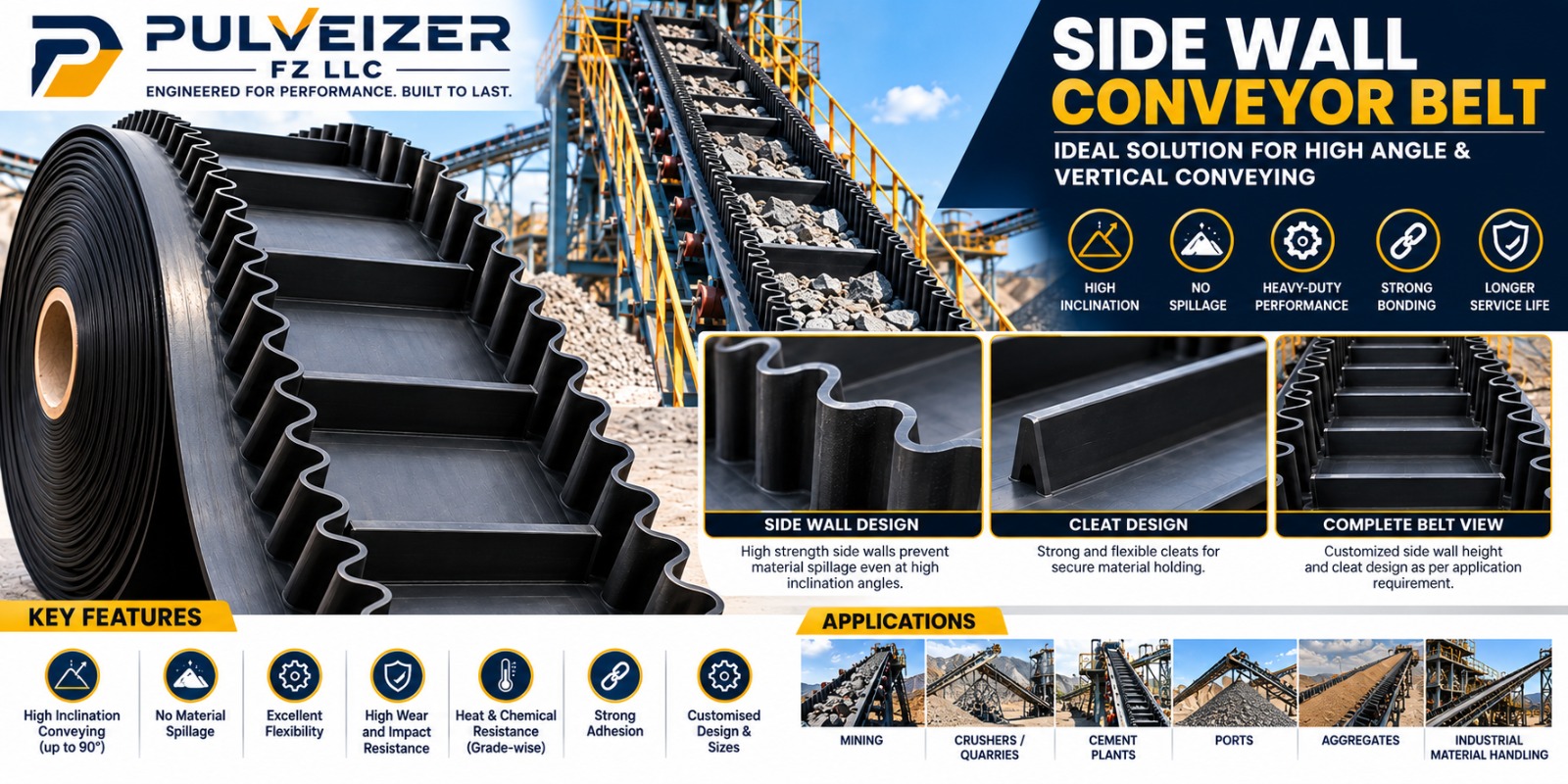
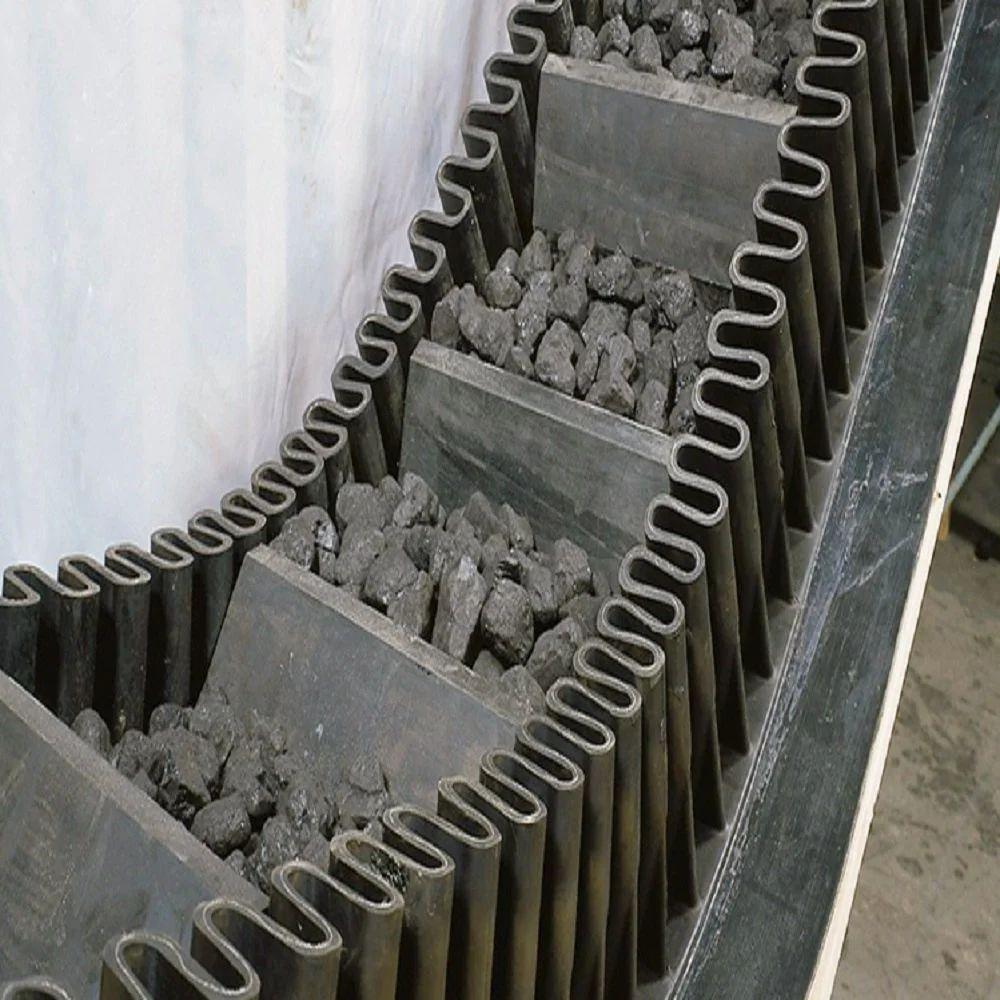
Construction – An Integrated Belt System
| Component | Engineering function | Typical options |
|---|---|---|
| Base belt / carcass | Carries belt tension and provides the structural foundation. | EP textile carcass; heavy-duty textile construction; steel-cord construction for higher tensions where required. |
| Rubber Core | Ensures proper adhesion between plies and absorbs impact. | |
| Top & bottom covers | Protect carcass from impact, abrasion, heat and environmental exposure. | Abrasion resistant; heat resistant; oil resistant; flame resistant; application-specific compounds. |
| Corrugated sidewalls | Contain material laterally and permit pocket formation. | S-type / C-type and application-specific profiles; multiple heights and configurations. |
| Cleats / flights | Retain material and divide the belt into carrying compartments. | T-type, C-type, T-G / C-G style and custom profiles; straight, stepped or application-specific geometry. |
| Bonding / vulcanization | Provides secure attachment of sidewalls and cleats to the base belt. | Hot-vulcanized construction recommended for demanding continuous-duty applications. |
| Edge / transition zones | Manage the change between flat and pocketed sections. | Engineered transition lengths and pulley/idler arrangements based on belt geometry. |
Technical Data – Pulveizer Engineering Range
The following is a practical engineering range for website/product selection. Final dimensions and ratings are confirmed against conveyor calculations, material characteristics and component geometry.
| Parameter | Pulveizer range / capability | Engineering note |
|---|---|---|
| Base belt width | Approx. 250–1600 mm | Wider systems can be engineered subject to carcass, sidewall and conveyor design. |
| Base belt thickness | Approx. 8–40 mm | Final thickness depends on carcass, covers, sidewall/cleat construction and duty. |
| Base belt thickness | Approx. 8–40 mm | Final thickness depends on carcass, covers, sidewall/cleat construction and duty. |
| Sidewall height | Application selected; engineered profiles can extend into several hundred mm | Profile height must be coordinated with cleat height, material angle of repose and pulley/transition geometry. |
| Cleat height | Application selected; typically coordinated with sidewall height | Cleat profile and pitch determine carrying pocket volume and return-side behaviour. |
| Conveying angle | From conventional incline through steep-incline applications; vertical configurations possible with suitable system design | The achievable angle is system-dependent, not a belt-only rating. |
| Temperature | Compound selected to application; heat-resistant constructions available | Do not select by temperature alone—material temperature, residence time and ambient conditions must be evaluated. |
| Cover grades | General purpose, abrasion resistant, heat resistant, oil resistant, flame resistant and other application-specific grades | Actual standard/approval is to be confirmed on the quotation or technical data sheet. |
| Tensile rating | Selected to calculated operating tension and safety factor | Textile and steel-cord solutions can be engineered for higher tensions. |
| Cleat/sidewall attachment | Vulcanized / integrated construction | Designed for strong adhesion and repeated flexing over conveyor components. |
Sidewall & Cleat Profile Selection
Profile selection is not simply a matter of choosing the tallest sidewall. The optimum combination depends on bulk density, particle size, moisture, angle of repose, feed rate, belt speed, inclination, lump impact, pocket volume and transition geometry..
| Profile family | Typical purpose | Selection consideration |
|---|---|---|
| Corrugated S / C sidewall | General steep-incline and pocket conveying | Good lateral containment with flexibility over transitions. |
| High sidewall profile | High-volume or larger pocket requirement | Requires matching cleat height and careful pulley/transition design. |
| T / C transverse cleats | Material retention and pocket formation | Cleat height, pitch and shape are selected to suit material flow. |
| T-G / C-G style high-performance cleats | Higher pocket volume / demanding steep-angle duty | Useful where increased material retention is required; exact profile selected by system calculation. |
| Custom cleat geometry | Special materials, high capacity or unusual conveyor route | Can be developed around particle size, inclination and discharge behaviour. |
Materials & Industries
- Mining & minerals – coal, iron ore, limestone, bauxite, aggregates and other bulk minerals.
- Quarries & crushers – crushed stone, sand, gravel, screened aggregates and fines.
- Cement & clinker handling – limestone, gypsum, additives and other bulk raw materials.
- Steel & metallurgical plants – ore, sinter-related materials, coke and process minerals.
- Fertilizer & chemical plants – granulated and powdered bulk products, subject to compound compatibility.
- Ports & terminals – bulk mineral and raw-material transfer where space and elevation are critical.
- Power plants – coal, ash and selected bulk fuel/material handling applications.
- Construction & infrastructure – sand, aggregate and other bulk construction materials.
- Salt & mineral processing – raw salt, washed salt and industrial mineral products.